Understanding Packaging Machinery Synchronization in Modern Production Lines
I’ll never forget a plant visit a few years back. The owner walked me straight to his new filler, rated for 10,000 bottles an hour, and he was beaming. Then we drifted over to the labeller and watched it stop, start, stop again. That’s a packaging machinery problem dressed up as a speed problem.
Here’s what I tell every owner who asks. Your plant doesn’t run at the speed of its fastest machine. The process operates at the pace determined by how well the packaging machines work together, which is made possible by packaging line synchronization. Whenever there is starvation in one place while the other is flooded with material, the process will be reduced to the minimum possible.
As you can see, the concept of packaging line synchronization may appear rather complicated, but the truth is, it is a pretty simple thing. It all works through synchronized movement of the machines, so that the bottles do not pile up, stretch, or fall. The bridge decides how fast everyone gets home.
Why Individual Packaging Machinery Speed Doesn’t Guarantee Higher Production Output
Let’s do the math, because it’s a bit humbling. If the probability of availability for your filler is 95 percent, your labeller is 92 percent, your capper 94 percent and your wrapper 93 percent, when you multiply all of them, you'll end up with 76 percent. That's why the 10,000 bottles per hour rate from the brochure? You can expect around 7,600 per hour. Even the best packaging machinery can’t argue with that arithmetic.
Why does it drop so far? Stoppages stack. With no buffer between machines, a 30-second jam on one unit freezes its neighbours too.
This is why packaging line balancing belongs before the purchase order, not after the first bad month. Balancing just means matching each machine’s real, sustained capacity (not the brochure number) so every downstream unit runs a touch faster than the one feeding it. That small surplus lets the line catch its breath after each hiccup. Honestly, packaging line balancing is mostly arithmetic. Good packaging machinery gets chosen as a team. Treat your packaging machinery as one system.
How Poor Synchronization Creates Bottlenecks in Beverage Packaging Lines
Most bottlenecks are boring. Three small things team up, and weak packaging line integration is usually the quiet cause.
Tiny speed mismatches
A conveyor running 3% fast bunches bottles at the next transfer. One running 3% slow leaves the machine ahead hungry. Nobody notices on commissioning day, which is exactly the problem.
Dead plates
Those little transfer plates between conveyors? Light bottles tip and wobble right there. One fallen bottle trips a sensor, and the whole line stops for a single bottle.
Accumulation zones that are too small
The labeller stops for a glue refill. The filler needs somewhere to put its bottles, and if the buffer fills in forty seconds, the filler stops too. When everything restarts, it surges, and the surge causes the next jam.
People often blame packaging line automation for this. The sensors did their job and halted the line, but packaging line automation can’t fix a bad layout. It just stops faster. Smart packaging line automation only pays off once the layout is sound.
Comparative Analysis: Unsynchronized Machines vs. a Synchronized Line
Here’s the side by side. The OEE ranges are what I commonly see on real floors.
| Parameter | Unsynchronized Standalone Machines (High Speed) | Fully Synchronized Packaging Line |
|---|---|---|
| Micro-Stops & Bottleneck Frequency | Frequent, with jams travelling up and down the line | Rare, because buffers absorb small stoppages |
| Overall Equipment Effectiveness (OEE) | Commonly 55% to 65% | Commonly 75% to 85% |
| Product Spillage & Container Damage | Higher: fallen bottles, crushed caps, spills at transfers | Low: gentle, pressure-controlled handling |
| Operator Stress & Manual Intervention | Constant, with operators acting as human buffers | Light, with operators supervising instead |
The Role of Filling, Capping, Labelling and Conveying Machines in a Synchronized Packaging Line
The wet end, with rinsers, fillers and cappers, is tightly coupled, so this packaging machinery wants steady feeding. These machines share timing and hate being interrupted mid cycle. The dry end, with labellers, wrappers and packers, is more forgiving but stops more often. Conveyors sit in between and act as translators.
That’s where variable frequency drives (VFDs) earn their keep. Rather than one fixed speed, a conveyor reads sensor feedback and eases up or down. So when a labeller faults, the filler slows gently instead of slamming into a wall.
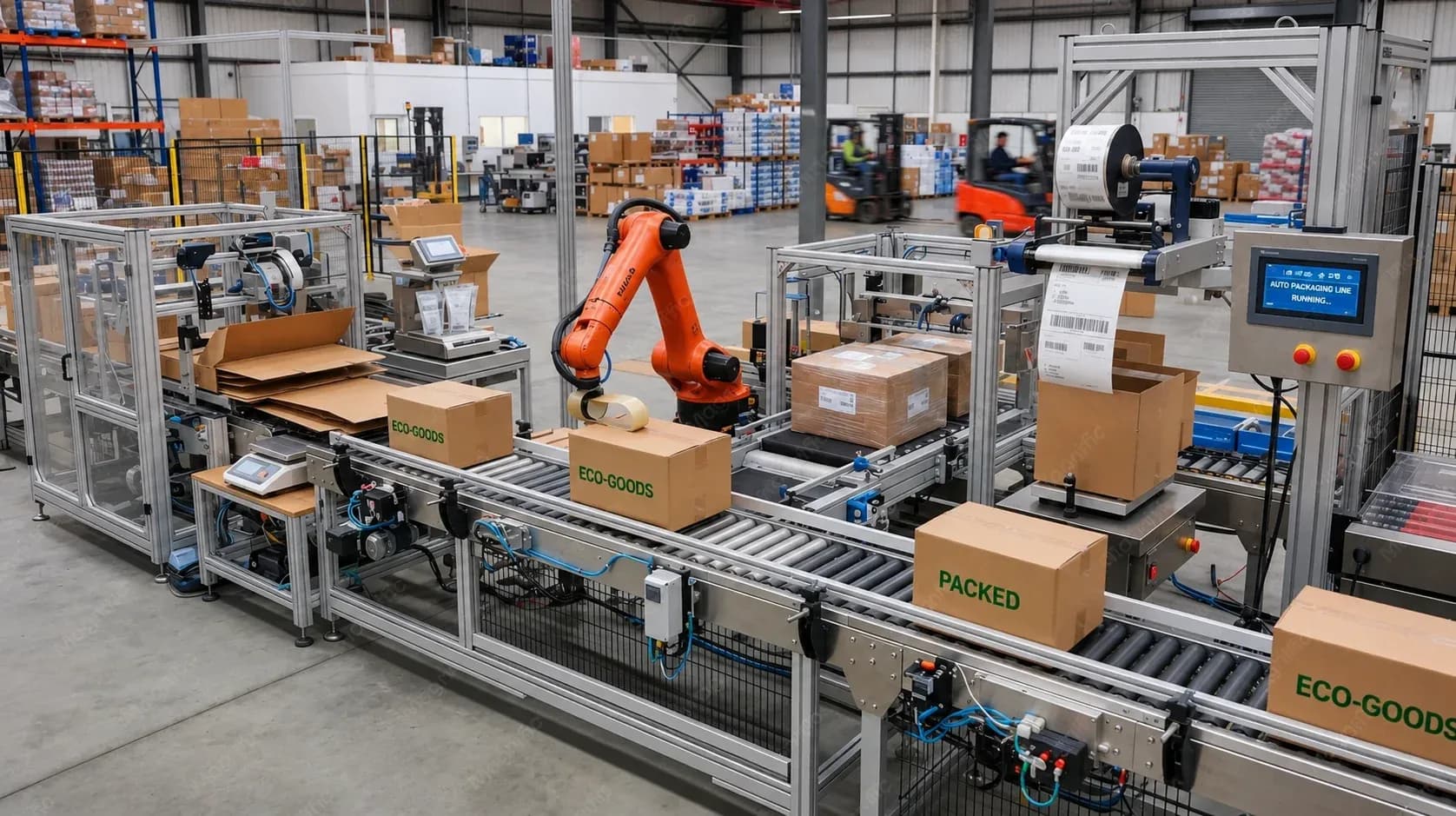
Good packaging line integration goes a step further. Machines swap simple signals: ready, full, starved, fault. Ideally it all runs through one control system, which is packaging line automation at its most useful. When each unit is aware of what its neighbours are up to, efficiency of production line no longer relies on good fortune, and packaging line automation can have clear signals to process.
Key Benefits of Packaging Line Synchronization for Production Efficiency
• Higher OEE: fewer micro stops, more scheduled hours turning into sellable product. That’s production line efficiency you can measure. • Less waste: gentle packaging machinery handling means fewer fallen bottles, crushed caps and spilled drinks. • Lower maintenance stress: packaging line synchronization spares your packaging machinery constant start stop wear, so drives, clutches and gearboxes last longer. • Predictable daily output: you can quote delivery dates with a straight face, and your sales team will notice. • Calmer operators: people supervise instead of firefighting. • Smarter spending: packaging line balancing shows where the next dollar of packaging machinery budget will actually pay back. • Better returns on equipment: every machine you already own gets closer to its rating, which lifts production line efficiency.
How to Optimize Packaging Machinery for Smooth and Continuous Beverage Production
- Measure first, then run packaging line balancing on real numbers. Log every stop for two weeks, with duration and location. The real constraint is rarely the machine everyone blames.
- Add sensors where bottles bunch or gap. Photo eyes and level sensors can feed the VFDs directly, which gives packaging line automation real data to act on.
- Use zero pressure accumulators. Bottles queue without leaning on each other.
- Size buffers to real stop times, not hopeful ones. That alone often lifts production line efficiency.
- Plan packaging line integration early so controls talk from day one. Do that, and even older packaging machines will perform significantly better. The new packaging machines perform even better, and integration of the packaging lines keeps them performing well.
Why Choose Seppa Solutions for Integrated Beverage Production and Packaging Lines?
Seppa Solutions treats the line as one machine, not a shopping list. The team starts with a custom layout design built around your bottle formats, target speeds and floor space. Then comes expert packaging line synchronization, with conveyors, accumulation and controls specified together. Finally, Seppa manufactures turnkey packaging machines for constant production line efficiency, from rinsers fillers cappers to labelling, packing, and palletizing operations, so that one partner owns the output. Seppa also handles packaging line integration for existing plants. Ask them to model your line before you buy a single unit.
Frequently Asked Questions About Packaging Machinery and Line Synchronization
1. How do I calculate the ideal accumulator size?
Multiply the line speed per minute by the average longest time the downstream machine stops, adding 20% to 30%. If the line is running at 10,000 bottles per hour, that’s about 167 bottles per minute, and a stop of two minutes would need 330 bottles of buffer stock.
2. How can I diagnose recurring micro stops?
Log them: the time, the machine, what the operator did. Within two weeks patterns show up, so fix the top three and recheck. Packaging line automation logs speed this up, and packaging line integration makes them reliable.
3. Can I upgrade a legacy floor without replacing everything?
Most times, yes. It normally takes less time than you think to see an efficiency increase in the production lines before any machinery replacement is made. First, install conveyors, sensors and variable frequency drives, then incorporate the accumulation systems and packaging lines through control integration.
4. How do I handle multi format changeovers?
Strong packaging line balancing covers formats too. Use quick change guide rails and store recipes in the controls. Changeovers that live in one veteran’s memory are fragile. Recipes aren’t.
5. What does a good packaging line balancing protocol look like?
For packaging line synchronization, measure true speeds, find the slowest sustained machine, then set each downstream unit a few percent faster than the one before it. Verify under load, then lock the settings. Packaging line balancing is never a one time job.